Nov 6, 2026 | News
“As a headmaster, you’re dealing with people, teachers, students, parents all day long. If you understand who they are as God’s creation, it just helps everything in your job.”
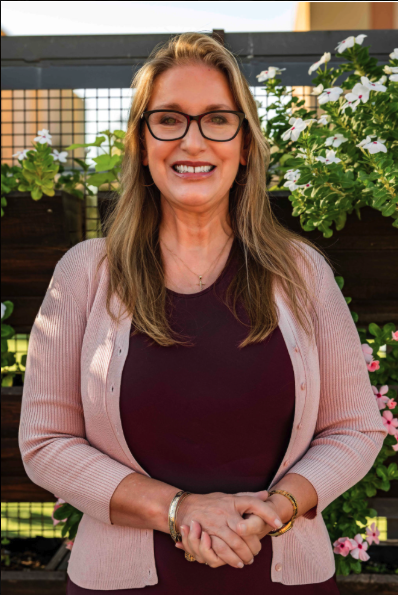 Stephanie Kaye first enrolled at Holy Apostles in the summer of 2020. After years as a music teacher and choir director, Kaye became a dean before accepting the position of headmaster at Great Hearts Archway Cicero in 2021. She served until 2025, when she took a sabbatical before retiring. Looking back on her theological studies at Holy Apostles, Kaye has no doubts about the value of her education. “It was the right degree, the right decision.”
Kaye believes God first drew her into teaching when the music teacher at her children’s parochial school quit midyear. Hired part-time to fill the vacancy, she discovered both an aptitude for teaching and a sense of calling. At 42, she returned to school to earn a
bachelor’s degree in music.
At Great Hearts, Kaye was soon asked to serve as a dean overseeing student behavior. After prayer, she accepted, eventually growing into a school leadership role. “God gave me that desire… even though I was very afraid to do it,” she says. In retrospect, she sees that her professional work also gave her a creative outlet as her daughters got older and it was a good transition at the right time for her family.
One of the things that Kaye noticed over her many years in education is the role of school culture in shaping a child. Having a virtuous school culture and intellectual virtue “are synergistic. That is what I really grew to learn through that work… saying ‘You better love Jesus,’ does not make anybody love Jesus. It’s the culture that they’re surrounded by.” Kaye became interested in studying graduate theology after hearing about Holy Apostles on The Patrick Madrid Show. After exploring schools listed in the Newman Guide, she decided to pursue a degree rather than take a single course. The M.A. in Theology with a concentration in Moral Theology offered a foundation for addressing student behavior, making disciplinary decisions, and discussing those topics with parents.
“What I would say to anybody in education is that philosophy and theology – when it’s properly taught and well-ordered – will inform everything else you do in your school. That is a base I wish I had before I got into it… If you’re educating the human person, you have to know what the proper end and purpose of the human person is, or you won’t be able to educate them.”
Returning to the classroom in an online setting was a natural experience. Kaye believes teachers and leaders should always remain students themselves. She found the professors very accessible and loved to partake in the occasional optional Zoom.
Kaye related an experience where she earned a C on her first paper from her professor, Fr. Brian Mullady, O.P., who has since passed away. “At first I was like, ‘Oh no, should I be doing this program?’ But then I was really happy because I knew this is someone who’s going to tell me the truth and I’m going to learn a lot. I got A’s in all of his classes, and his finals were probably the most difficult that I ever took. He just raised me to another level and I know that was love.”
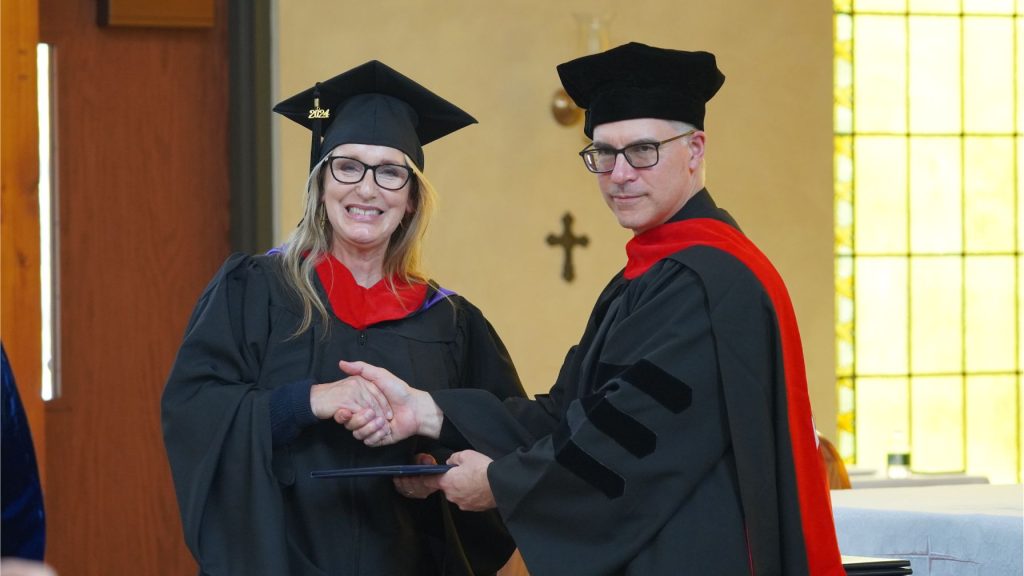
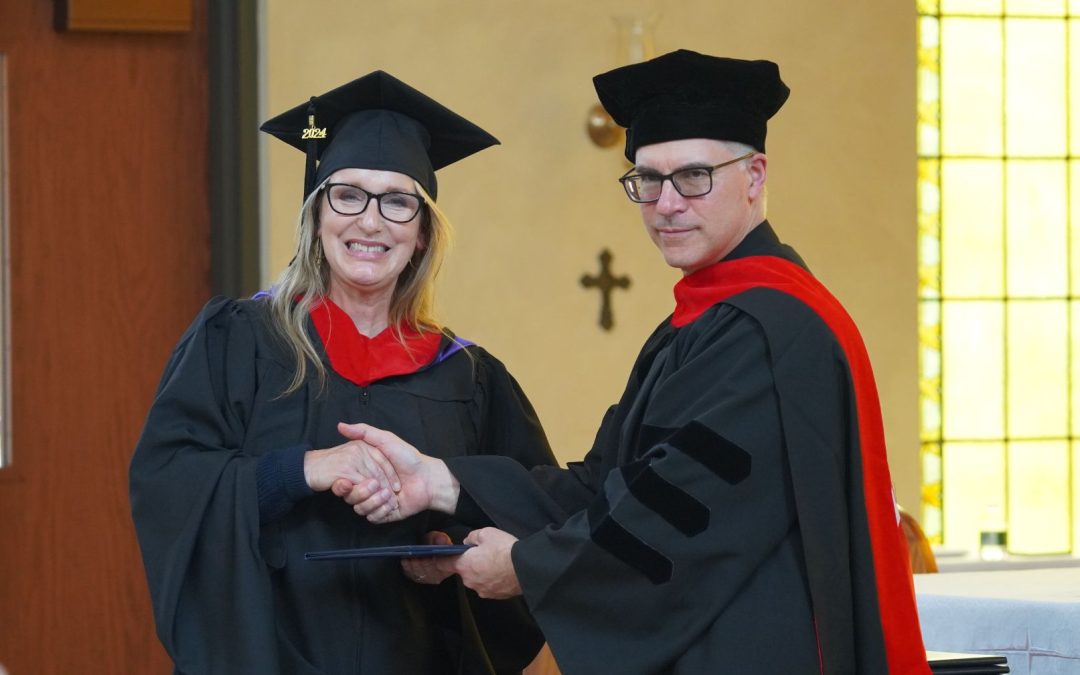
Attending her 2024 graduation ceremony in person became one of Kaye’s most memorable experiences. She almost didn’t come because of the timing of the graduation and the demands of her work that year. However, she is so glad she made the trip from Arizona to Connecticut. She shared that graduation was “just this breath of fresh air that I needed, and I hope everybody knows it’s worth it… [E]verything exceeded my expectations. It was like a pilgrimage coming to a really holy place.” Meeting fellow graduates whom she had only known online provided a lasting sense of connection.
In retirement, Kaye is putting St. Teresa of Calcutta’s maxim into practice: “If you want to change the world, go home and love your family.” She just launched a part-time Catholic classical homeschool called Sancti Futuri (Saints of the Future). She also has the desire to grow in her faith through learning about the lives of the saints and Doctors of the Church and through living a devout life. Most of all, though, Kaye describes her desire to get to know her husband better. As her vocation of marriage takes center stage, she enters this new chapter trusting in God’s providence.
Sep 1, 2026 | Alumni, News
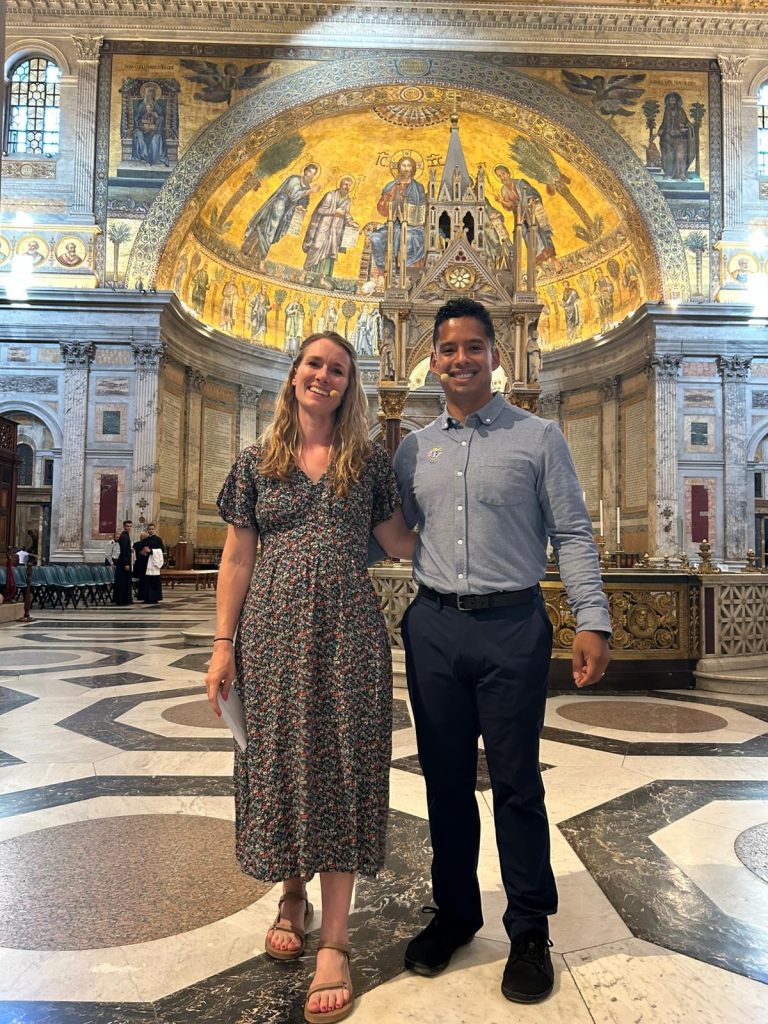 Renzo Ortega and his wife, Monica, started their podcast, Two Become Family, in 2022. In the wake of COVID-19 and virtual marriage prep, the Ortegas decided to launch their ministry after years of work as marriage preparation coordinators and facilitators. Their ministry is built around sharing the practical applications of authentic Catholic theology within marriage and family life. Besides their weekly podcasts, which aim to “restore confidence in marriage and family life” through accompaniment and their real-life experience of marriage, the Ortegas are also fellows at the St. John Paul II Foundation and travel nationally as speakers for the Together in Holiness marriage conference series.
Today, they have a wide audience in the Catholic sphere and have appeared on features from EWTN and the Knights of Columbus. They have also authored or co-authored three books, including Lovemaking: How to Talk about Sex with Your Spouse and the family devotional Go to Joseph for Children. Renzo is also the author of the forthcoming book Quest for the Male Soul: Discover What Your Life is For, which will be published by Ave Maria Press in January 2027. Their experience of living a Catholic marriage is not only relatable, but also authentically grounded in the perennial truths of the Catholic faith, where they witness the good and the hard coexisting. This hopeful dimension to their work truly makes them Catholic leaders in the New Evangelization. We were happy to sit down with Renzo, who graduated from Holy Apostles in May 2022 with a Master of Arts in Theology (Apologetics concentration), to hear more about his experience as a student and how that impacts his ministry with his wife.
1. How did studying theology and apologetics at Holy Apostles shape the way you think about communicating the Catholic faith—not just academically, but especially in the context of everyday marriage and family life?
Studying theology and apologetics taught me that communicating the Catholic faith is not just about having the right answer. The truth must be communicated clearly, but it must also be communicated in a way that helps people recognize how that truth speaks into the circumstances of their lived experiences.
Many Catholics know that the Church has beautiful things to say about marriage and family life, but they still struggle with the human, day-to-day reality of living out those teachings. There can be a real gap between understanding the theology of marriage and knowing how to live it around the kitchen table.
My education helped me become more confident in entering that gap, because it gave me the theological foundation to remain faithful to the Church while translating complex ideas without compromising their depth. That has shaped everything Monica and I do. We want people to encounter the wisdom of the Church, but we also want them to feel accompanied by people who understand that marriage is beautiful, sacramental, holy, and also deeply human.
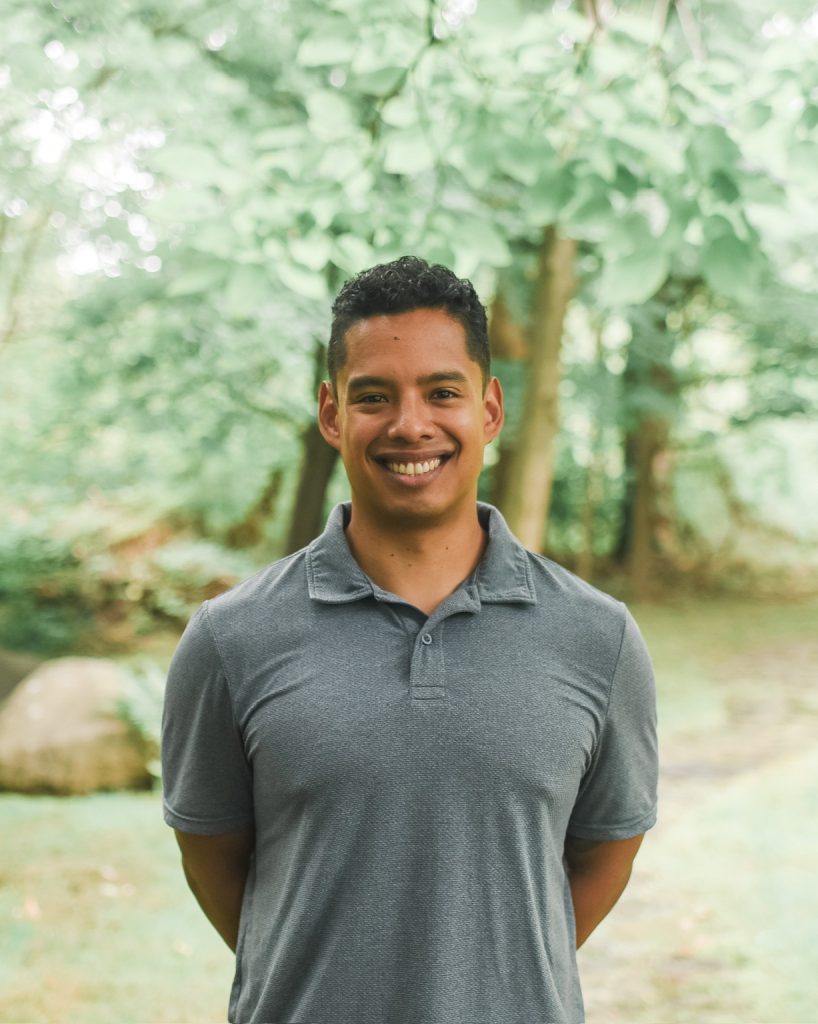 2. You graduated from Holy Apostles in 2022, the same year you launched Two Become Family with Monica. How did your experience as a student intersect with or prepare you for the ministry you are doing today?
My studies and the launch of Two Become Family were deeply connected. Monica and I began the ministry because young adults we had previously served in youth ministry were entering serious relationships, discerning marriage, and beginning families of their own. They were asking important questions, and we wanted to remain connected with them and continue those conversations.
Holy Apostles gave me the theological framework to engage those questions responsibly. At the same time, our own marriage gave us the lived experience to recognize that people usually need more than information transfer. They need accompaniment, authentic relationships, and the witness of couples who are willing to speak honestly about both the grace of the sacrament and the very real human formation marriage requires.
That intersection has become central to our apostolate. We are not interested in merely repeating theological concepts, but we also don’t want to offer advice based only on our personal experiences. My time at Holy Apostles prepared me to do that with greater confidence, clarity, and fidelity.
3. For someone considering studying at Holy Apostles, what would you say they can gain from the experience beyond earning a degree, especially if they hope to use their education in ministry or evangelization?
Beyond earning a degree, Holy Apostles can give a person the intellectual and spiritual tools to continue learning long after the program ends. Ministry constantly presents questions you have never encountered before. No degree can prepare you with a memorized answer for every pastoral situation, but a strong theological education can teach you where to look, how to think, and how to discern whether an answer is faithful to what the Church has given us.
It can also give you greater humility. The more deeply you enter the treasury of the Church, the more aware you become of how much you do not know. My time at Holy Apostles did not produce insecurity but freed me from believing that ministry depends upon my ability to be the expert in every room.
For someone hoping to serve in ministry or evangelization, that combination of confidence and humility is incredibly important. You become better equipped to accompany people searching for God, meaning, and direction without making yourself the center of their journey.
Apr 8, 2026 | News
We commemorate our deceased members of the Holy Apostles family and request that you keep them in your prayers. Eternal rest grant unto them O Lord, and let perpetual light shine upon them. May their souls and the souls of all the faithful departed, through the mercy of God, rest in peace. Amen.
Reverend William Vincent Callery, Jr., known affectionately as Father Bill, passed away on November 6, 2025, at age 84. A Pittsburgh native and Duquesne University graduate, he first served as a U.S. Army officer before discerning a call to the priesthood. He prepared for ministry at Holy Apostles College & Seminary and Sacred Heart Seminary and School of Theology, and was ordained for the Diocese of Fargo in 2001. He went on to pastor several North Dakota parishes and continued assisting in ministry even in retirement.
Father Bill will be remembered for his humility, steadfast faith, and lifelong dedication to serving the Church and his communities.
Reverend Victor Chaker, 91, died on February 3, 2026. Father Chaker was born in Port Said, Egypt in 1934, immigrated to the United States, and before entering the priesthood was an accomplished engineer, husband, and father. After his beloved wife died, Victor entered Holy Apostles Seminary and received his MDiv on May 9, 2003, and was ordained a priest for the diocese of Norwich on May 31, 2003.
He served the faithful of St. Mary Parish in Coventry as a summer parochial vicar, parochial vicar, and pastor, and later retired from active ministry. He also served the Legion of Mary as Diocesan Spiritual Director. Father Chaker is survived by his grandchildren, great-grandchildren, and three living sisters.

Mar 5, 2026 | Alumni, News
A childhood marked by instability might not seem like the foundation for a life in Catholic leadership. Yet for Dr. Paul Chutikorn ’19, MA ’21, each twist and turn became part of a providential path leading him to Christ and His Church. With no religious upbringing to guide him, his journey began with a simple but powerful desire: to make dramatic changes in his life and build a better future for his family. What began as a search for order and a more moral life became something far greater—a discovery of the historic truth and beauty of the Catholic faith, and ultimately a calling to evangelize through teaching and leadership.
A Life Redirected
Dr. Chutikorn grew up in what he describes as a hectic environment. His parents divorced when he was only two years old, and he lived with his father until the age of nine. Paul then moved in with his mother, who was a real estate property manager, a profession with the downside of frequent relocation. Unfortunately, she battled personal problems, and as a result, Paul did not have the supervision a child needs. Although he did not get into trouble himself, he hung around with his cousin, who became involved with drugs and gang affiliation. Paul admits that, while not getting involved, he became attracted to the family-like, protective environment the gang brought—albeit destructive.
Paul’s life took a dramatic turn when he became a father at 16. After taking a year off from school to put his life in order, he completed high school and moved his future wife and child to Oregon to be near his sister. He felt a small-town environment was a better and more affordable place to raise a child.
While growing up, he and his siblings had no exposure to any religion at home. In high school, however, his sister joined a Christian youth group and, in Oregon, attended a Protestant nondenominational church. Now living in Oregon, Paul began attending the same church and loved it. He found that it helped him work toward his goal of becoming a more moral person and bring order to his life. His guiding principle was that he did not want his daughter to live the life he experienced, and he was doing everything possible to do something different.

Discovering the Catholic Church
During this time, when attending church and Bible studies, he began to love the person of Jesus Christ. Unfortunately, a strong anti-Catholic sentiment within the Bible study classes led him to develop a negative opinion about the Catholic faith. An important moment came when his brother, who was originally a Protestant, fell in love with and converted to Catholicism. Paul and his brother had heated discussions and, with the intention of proving his brother wrong, Paul did research into Church history. As he read, he realized that his brother was actually correct about the Catholic Church being the true legacy of Christ. As he put it, “The early Church looked remarkably Catholic.” He and his wife converted to Catholicism in 2009.
On fire with love for Christ and the Church, he hungered to learn more and share the information through teaching. He enrolled in the Holy Apostles online studies program in 2016, just two years after it was fully approved, after hearing about it from his brother. The program, grounded in principles of Thomistic philosophy and theology, was something Paul had been looking for and could not find at any other college. In 2019, Paul earned an undergraduate degree in Theology and Philosophy.
Still on fire, Paul immediately began pursuing his Master of Theology degree, concentrating on Thomistic studies. This, again, was a new program that had launched in 2019, at the same time he graduated with his undergraduate degree.

Teaching, Leadership, and Providence
After earning his graduate degree, he began working as a teaching assistant (TA) at Holy Apostles, while also maintaining a job as Director of Faith Formation at his local parish. When a position opened in 2020, Paul began his adjunct career as the instructor of Moral Theology.
While holding this adjunct position, Paul pursued a Doctor of Education (EdD), which he realized would enable him to provide for his seven children and offer additional opportunities for him to teach and lead. As with so many of the opportunities that came before, the hand of God was at work again. When Paul was completing this program, Holy Apostles posted a job opening for the position of associate dean. He applied and became the Associate Dean of Online Learning at Holy Apostles in September 2024, while maintaining his adjunct teaching position.
Describing this journey, Paul explains, “I have been very, very blessed. It has not been a smooth ride; it’s been a busy schedule—having seven children, going to school, and working. That has been quite difficult, but the whole journey has been a complete blessing.”

Jan 7, 2026 | News
How two priests in the Diocese of Sioux Falls bring life experience into joyful service of the Church.
Our lives are shaped by what we have lived—and by how we allow God to use it. That truth is especially evident in men who discern a later vocation to the priesthood. Rather than leaving their past at the door, they bring it to Christ, and their experiences become instruments of mercy, wisdom, and steady pastoral care.
Fr. Tom Hartman (BA ’14, MDiv ’17)
Fr. Tom Hartman, a priest of the Diocese of Sioux Falls, South Dakota, knows what it means to rebuild a life on faith. In his youth, his relationship with God was fractured. After high school, he married and became the father of two children. Years later, he endured a divorce and subsequently received an annulment.
In the midst of that painful time, Tom recalls hearing the Lord ask him, “Are you doing that well without me?” When he recognized the honest answer—no—he returned to the Church. With the guidance of his parish priest, he came to understand a hard but lasting lesson: suffering with God is difficult, but suffering without Him is misery.
After the divorce and annulment, Tom immersed himself in the life of faith. He dated off and on for ten years, but over time he began to see that dating was pulling him away from wholehearted service. As Fr. Tom explains, “This was my discovery of a priestly heart—that it wasn’t meant exclusively for one, but to give it over to Christ and His Church.” At 41, he entered Holy Apostles.
Looking back, Fr. Tom describes his time there as a gift of peace and clarity. He says, “I am Franciscan in spirit, and I loved the holy simplicity that came from Holy Apostles. It was my initial impression and my last description upon being ordained: Holy Apostles has a simple holiness to it.”
He believes he gained practical tools to answer many questions, while also learning something every priest eventually discovers: no seminary can fully prepare a man for everything a diocesan priest and pastor will face. Still, the formation helped him develop the habit of self-formation—a steady discipline of prayer, study, and growth that continues long after ordination.
Today, Fr. Tom serves as pastor of the Holy Family Pastorate in South Dakota, which includes St. Lawrence, Milbank; St. Mary, Clear Lake; St. Charles Borromeo, Big Stone City; St. Mary, Wilmot; and Annunciation, Revillo. Reflecting on his vocation, he says, “The vocation of priesthood is hard but beautiful. I think this is true when lived well in marriage as well. So, despite all the demands that go into running a parish/pastorate, this is where God wants me, and it brings me peace.”

Fr. Tom Hartman with his family
Fr. Dan Smith (MDiv ’10)
 Fr. Dan Smith’s call to the priesthood began early. When he was eight years old, he told his mother that he thought he would someday be a priest. He was right—just not right away.
After college, Dan ran his own ranch and later worked as a banker. In 2005, at 35 years old, he entered the seminary. He is grateful for a place like Holy Apostles, and he credits its formation with shaping students in the full breadth of Catholic life. He points to the community itself: laity, ordained, and consecrated religious—both professors and students—people from every background who share one common desire: to grow closer to Jesus Christ.
He also highlights the distinctly Eucharistic rhythm of seminary life. Holy Apostles, he says, is Eucharistic-centered in teaching and practice, forming men through Holy Hours and the Holy Sacrifice of the Mass. As Fr. Dan puts it, “This formation, as well as the sound philosophical foundation, prepares a person to handle what they encounter outside the seminary—in parishes, chapels, and on street corners. It prepares you for life, for the world… all for the salvation of souls.”
Fr. Dan now serves as chaplain at Sanford Hospital in Sioux Falls, providing emotional and spiritual support to patients, families, and staff. Over the years, he has kept Holy Apostles close to his heart—and he has acted on that gratitude in a very practical way. He regularly sends gifts to seminarians, including coats, shoes, books, and other useful items.
He remembers receiving similar kindness as a student. While he was at Holy Apostles, the Director of Library Services, Professor Claire Adamo, ran a book fair where seminarians could purchase books at affordable prices. There were also donations of clothing, liturgical items, and suit coats—one of which Fr. Dan received and still owns.
That spirit of generosity left a lasting impression. Now, when he comes across items he believes will help others, he continues the same practice of giving he experienced as a seminarian. As he explains, “Holy Apostles Seminary has this charism of gift that began with Fr. Eusebe Menard, who gave the gift of Holy Apostles as a seminary for later vocations. So, when I come across things… I will place them in a box and mail them to Holy Apostles, further continuing this gift charism.”
Winter in South Dakota
Life and ministry in South Dakota come with a challenge familiar to anyone who has lived through a New England winter—and then some. Winters at our campus in Cromwell can be snowy, but on the plains they can be severe, isolating, and even dangerous. Fr. Dan, Fr. Tom, and their brother priests are to be commended for the perseverance it takes to serve faithfully through months of harsh weather.
As Fr. Dan notes with a smile, “The Laura Ingalls Wilder books do not lie. It can be dangerous in the rural areas where priests sometimes have to drive 40 miles to the next parish.” In bad weather, they often stay close and serve the immediate area rather than take unnecessary risks. But rural ministry still demands travel—sometimes long miles on winter nights, scanning the roadside for deer, navigating blizzard snowdrifts, and driving roads lit only by starlight.
In those conditions, preparation is part of pastoral care. A supply bag becomes essential: candles, candy bars, layered clothing, snow boots, and the liturgical supplies needed for the sacraments. And, of course, a well-maintained, dependable vehicle matters—Fr. Dan’s has just hit 500,000 miles—along with the prayers of parishioners for safe travel.
God Shapes His Shepherds
The paths to the priesthood are not all the same. Yet in each vocation—early or late—the Lord forms a shepherd for His people. In Fr. Tom and Fr. Dan, we see how God can take real-life experience—joys, losses, work, family life, endurance, and generosity—and shape it into steady, compassionate priestly ministry.
Please keep these priests, and all our priests, in your prayers—especially those who serve in rural communities and difficult conditions—so that, in every season, they may continue to bring Christ to His people.